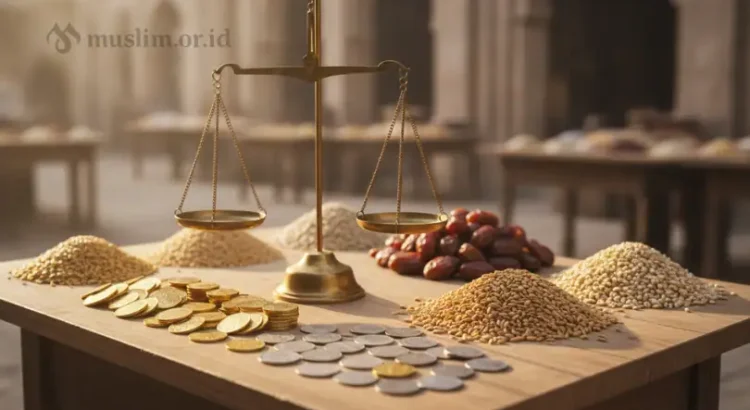
After discussing ‘perfume in the six usury buying and selling commodities, among the discussions that are no less important is knowing what provisions are contained in usury spell’ (usury buying and selling). Refreshing your memory, usury is divided into two:
- usury mermaid (usury related to debts and receivables)
- usury spell’ (usury related to buying and selling)
Please note that the six commodities mentioned in the hadith of ‘Ubadah bin Shamith May Allah bless him and grant him peace is included in the discussion of usury spell’ and not usury mermaid. So this provision cannot be separated from the six ribawi commodities or goods similar to these commodities.
It has also been explained regarding the circumstances and conditions of ribawi commodity transactions involving usury spell’, (in writing Usury Fiqh Bag. 9). In short, there are four situations:
First: Exchange items of one type and one ‘perfumelike exchanging gold for gold.
Second: Exchange items of different types and one smell like exchanging gold for silver.
Third: Exchange different items ‘illat ribawi and different types, such as exchanging gold for rice.
Fourth: Exchanging goods that are not included in the ribawi goods category, such as exchanging books for pens.
As has been explained, in these four situations, there are separate terms and conditions that must be fulfilled. Such as having to be of the same type, equal in weight and measure, and the goods being exchanged must be given in cash.
Specifically, this discussion will explain the provisions above.
Provisions “must be similar”
What is meant by must be like in exchange?
Please be aware of that al-jins (type) linguistically is,
Comprehensive of various types of things
“A term that covers a variety of different things.”
As for an-nau’ (sort of) linguistically is,
Comprehensive various things with each personality
“A term that covers various things with different units.”
An example of “type” is dates and examples of “sorts” are Ajwa dates, Sukari dates, and so on. Another example, rice is called a “type”; As for pandan rice, brown rice, or rojolele rice, these are all called “kinds”.
– So the rule is that every two types that come together under one special name, then both are one type. As in the example mentioned above, Ajwa dates and Sukari dates are the same type. Likewise with pandan rice, brown rice, or rojolele rice, these are all the same type; because overall, everything is rice.
This means that even though the names are different, they are still of the same type. What are the consequences? The consequence is that equality and similarity must remain, and there must be no excess (difference) when an exchange transaction occurs. For example, between Ajwa dates and Sukari dates; when the two are exchanged, there cannot be more in the measure. If there is more, this is what is called usury fadhl.
As explained in the hadith ‘Ubadah May god bless you, The condition that there should be no differences is if they are exchanged for the same type. Among the scholars, there is no difference regarding the issue of mandatory equality in the exchange of similar ribawi goods or commodities, even though the types are different.
Hence, Prophet sallallaahu ‘alaihi wa sallam prohibits buying and selling winner. Abdullah bin Umar May Allah bless him and grant him peace said,
Rasulullah SAW prohibited muzabanah and muzabanah from buying fruit the size of dates and vineyards the size of raisins.
“The Prophet sallallaahu ‘alaihi wa sallam prohibited the buying and selling of muzabanah. Muzabanah is buying wet dates (which are still on the tree) with dry dates by measuring them, and (buying) wet grapes with raisins (dried grapes) by measuring them.” (Muttafaqun ‘alaih)
Why buy and sell? muzabanah is this prohibited? Because the two goods being exchanged are of the same type, of course there must be no more conditions in the exchange. Where does the extra come from? What’s more, when wet dates are exchanged for dry dates, there is a difference in dosage. When the wet dates dry out, the measure and weight will decrease. That’s where the usury lies.
Prophet sallallaahu ‘alaihi wa sallam been asked,
He, may Allah SWT and peace and blessings be upon him, was asked about buying dates with dates. He asked, “Do dates decrease when they are dry?” They said yes. Then he said no
“That he, may Allah be pleased with him, and give him safety, was once asked about the rules for buying dry dates (tamr) with wet dates (ruthab). He also asked, ‘Will wet dates decrease (in weight) ifedry?’ The companions answered, ‘Yes’. He then said, ‘If that’s the case, then don’t (do it)’.” (HR. At-Tirmidhi)
Are all special names necessarily categorized as the same?
Discussing more deeply about “type” which is related to similarities in specific names, are all specific names definitely categorized as similar?
The similarity in specific names is tied to two things:
First, The similarity must be in meaning, not just in pronunciation (speech). This is to exclude goods or objects that have the same name, but different essence.
For example, Javanese sugar (palm/brown sugar) with granulated sugar. Both have the same name, but their essence is different. One from sap/coconut sap, the other from sugar cane. So that the two are not the same type, 1 kg of Javanese sugar can be exchanged for 2 kg of granulated sugar by bartering without causing usury. just for fun.
Second, both goods must be united in one source. If two items of the same special name come from two different origins, then they are two different types.
Examples include wheat flour with corn flour or apple cider vinegar with grape vinegar. According to a number of scholars, this is a different type even though the name is the same. This is because the sources are different, even though the names are both flour and vinegar. So that when a transaction occurs in the form of barter, it is not subject to usury just for fun.
These are the matters relating to the provisions of al-jins (type) in the discussion of ribawi commodities. God bless.
[Bersambung]
BACK TO SECTION 12
***
Depok, 3 Zulhijah 1447/ 20 May 2026
Writer: Muhammad Zia Abdurrofi
Article Muslim.or.id
Footnote:
This discussion is taken from the book Sahih Fiqh Sunnah/Kasyful Akinnah (5: 185-188), with some changes.
Reference:
Abu Malik Kamal bin Sayyid Salim. Sahih Sunnah Fiqh. Volume 5 (Kasyf al-Akinnah). 2nd printing. Egypt: Maktabah At-Taufiqiyyah, 2016.
PakarPBN
A Private Blog Network (PBN) is a collection of websites that are controlled by a single individual or organization and used primarily to build backlinks to a “money site” in order to influence its ranking in search engines such as Google. The core idea behind a PBN is based on the importance of backlinks in Google’s ranking algorithm. Since Google views backlinks as signals of authority and trust, some website owners attempt to artificially create these signals through a controlled network of sites.
In a typical PBN setup, the owner acquires expired or aged domains that already have existing authority, backlinks, and history. These domains are rebuilt with new content and hosted separately, often using different IP addresses, hosting providers, themes, and ownership details to make them appear unrelated. Within the content published on these sites, links are strategically placed that point to the main website the owner wants to rank higher. By doing this, the owner attempts to pass link equity (also known as “link juice”) from the PBN sites to the target website.
The purpose of a PBN is to give the impression that the target website is naturally earning links from multiple independent sources. If done effectively, this can temporarily improve keyword rankings, increase organic visibility, and drive more traffic from search results.