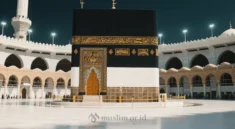
Visit Baitullah al-Haram, The Kaaba is every Muslim’s dream. One of the perfect pillars of the Islamic religion is the Hajj pilgrimage. Some scholars also believe that Umrah is an obligation for Muslims who can afford it. That way, we should learn what worship services we can perform when performing the Hajj and Umrah.
Among those that have been discussed recently is the hadith regarding prayer when looking at the Kaaba. What is the status of this hadith among the scholars? To answer this, we first need to know the pronunciation of the hadith which is often quoted in this matter. Among the most lafaz famous is taken from the hadith,
Every time the Prophet saw this House, he would say: O Allah, increase the honor, majesty, reverence and awe of this House, and increase the honor and generosity of those who perform Hajj or Umrah to it. Honor, honor, reverence, admiration, and truth
“O Allah, add to this house majesty, majesty, respect and authority. Also add to those who glorify and glorify it by performing the Hajj or Umrah. Add majesty, honor, majesty, authority and goodness.” [1]
This prayer is often referred to as the prayer that is read when you first see the Kaaba. In fact, some Hajj and Umrah pilgrims consider it to be part of the specially recommended sunnah. However, is it true that this prayer came from the Prophet? sallallaahu ‘alaihi wa sallam? What is the history of this hadith?
History of hadith
First, Makhul hadith
This hadith was narrated from Makhul God bless This history was mentioned by Ibn Abi Shaybah in al-Mushannaf [2]. He narrated from Waki’, from Sufyan, from a man from Syria, from Makhul, that when the Prophet SAW sallallaahu ‘alaihi wa sallam looking at the Kaaba, he read,
O Allah, enhance this house with honor, majesty, and awe, and enhance the Hajj or Umrah performed in it with honor, majesty, honor, and piety.
this history dha’if for two reasons:
- Makhul is a person or log in, while he narrated directly from the Prophet sallallaahu ‘alaihi wa sallam (without intermediary friends). So, this history is a hadith wife, and hadith Mursal is part of the hadith dha’if.
- In this sanad there is an unknown narrator, namely “a man from the Sham”, thus adding to the weakness of the narrative. This story is also mentioned by Al-Bayhaqi in al-Sunan al-Kubra [3]. In his sanad there is Abu Sa’id asy-Syami. However, Abu Sa’id asy-Syami was considered a liar. Al-Hafizh Ibn Hajar al-Asqalani said in at-Talkhis al-Habir [4]: “Kadzab (liar).” Thus, this Makhul route cannot be used argument.
Second, the hadith of Ibn Juraij
This hadith was narrated from Ibn Juraij God bless from the Prophet sallallaahu ‘alaihi wa sallam. This history is mentioned in Musnad Shafi’i through the composition of Abu Said Sanjar bin Abdullah al-Nashiri al-Jawli [5]from Sa’id bin Salim, from Ibn Juraij. This story was also narrated by al-Baihaqi God bless in the al-Sunan al-Kubra [6]. This Sanad is valid up to Ibn Juraij. Sa’id bin Salim assessed tsiqah by Yahya bin Ma’in and evaluated “do not do it” by an-Nasa’i. However, the weakness lies in Ibn Juraij’s history of the Prophet sallallaahu ‘alaihi wa sallam. Ibn Juraij is a person or log in, so the history comes directly from the Prophet sallallaahu ‘alaihi wa sallam including hadith mu’dhal, namely a hadith where two or more narrators fall out sequentially in its sanad. And hadith mu’dhal including hadith dha’if. Al-Hafizh Ibn Hajar said deeply at-Talkhis al-Habir,
This was the dilemma between Ibn Jurayj and the Prophet, may God bless him and grant him peace
“This history is mu’dhal between Ibn Juraij and Rasulullah SAW.” [7]
Al-Baihaqi also stated that this history was interrupted (carrot’). Thus, Ibn Juraij’s path also cannot be used as evidence.
Pray when looking at the Kaaba
Then, after knowing that prayer to see the Kaaba has degrees Mursal And mu’dhal or dha’if which cannot be a reference, what about the law of praying when looking at the Kaaba?
Praying when looking at the Kaaba was once done by the Prophet as narrated by Imam Muslim, in a long hadith it is said that,
When he had finished going around it, he came to Al-Safa, and he climbed it until he looked at the Kaaba, and he raised his hands and began to thank God and pray as he wanted to pray.
“After he finished his betrayal, he went to Shafa, then climbed there until he saw the Kaaba. Then he raised his hands, then praised Allah and prayed whatever prayer he wanted.” [8]
This hadith shows that the Prophet May Allah bless him and grant him peace indeed pray when looking at the Kaaba. However, it should be noted that this incident was not in the context of the first time seeing the Kaaba, but when he was on the Shafa after completing surround Therefore, this hadith cannot be used as a proof that there is a special prayer when you first see the Kaaba.
However, from this hadith it can be taken as an important principle that praying when looking at the Kaaba is generally something that is permissible. In fact, these places and moments are among the times and conditions that have a great opportunity for prayers to be answered.
As mentioned in Book of Fatawa Syabakah Islamiyyah,
He prayed whatever He wanted, because God Almighty had commanded His servants to pray to Him and promised them answers, and this view – that of seeing the Kaaba – was one of the best places to pray.
“A person can pray whatever prayer he wishes. Allah Subhanahu wa Ta’ala has ordered His servants to pray to Him and He has promised to grant it. And this moment (i.e. when looking at the Kaaba) is one of the best places and times to pray.” [9]
Abd Allah bin Muhammad al-Ghunayman also mentioned in Sharh Fath al-Majid,
There are no special requests that must be memorized to visit the Holy House. Seeing the House is a prayer in the hadith which has a weak narrative chain. A person should try to read prayers that suit him and what he needs for himself, then he prays to God with these prayers.
“There are no special prayers that must be memorized when visiting Baitul Haram. There is indeed a history of prayer when you first see the Kaaba, but the hadith is weak. Therefore, a person should earnestly pray according to his needs and circumstances, asking Allah for the prayers he feels he needs most.” [10]
Conclusion
First, The prayer that is popularly read when looking at the Kaaba is not authentic from the Prophet shalallahu ‘alaihi wasallam. The history that mentions prayer revolves around Makhul and Ibn Juraij, both of whom had nothing to do with the Prophet. May Allah bless him and grant him peace (Mursal And mu’dhal), some of the tracks even contain weak and accused narrators. Therefore, this prayer cannot be used as a special sunnah taught by the Prophet May Allah bless him and grant him peace.
Second, It’s okay to pray when you see the Kaaba. This is shown by the authentic history that the Prophet May Allah bless him and grant him peace pray when looking at the Kaaba from the top of the Shafa. Although not in the context of seeing the Kaaba for the first time, this hadith shows the permissibility of praying in general. So, a Muslim can pray any prayer according to his needs and desires, without specializing in certain pronunciations or believing that there is special guidance at that moment.
Third, when someone wants to read the prayer narrated by Imam asy-Shafi’i because of its good meaning and in accordance with the majesty of the Kaaba which reads,
O Allah, increase in this house honor, respect, honor and admiration, and increase the honor and generosity of those who perform Hajj or Umrah to it. Honor, honor, reverence, admiration, and truth
then that’s okay. However, what needs to be emphasized is that you cannot believe that this prayer is a special sunnah when looking at the Prophet’s Kaabahalallahu ‘alaihi wasallam or have certain preferences that are not based on valid arguments.
Also read: Get to know Baitul Makmur: The Kaaba that inhabits the sky
***
Writer: Muhammad Insan Fathin
Article Muslim.or.id
Footnote:
[1] Imam al-Bayhaqi, and-Sunan and Shagar2: 171.
[2] Imam Ibn Abi Shaybah, al-MushannafNO. 30240, 15:317.
[3] Imam al-Bayhaqi, al-Sunan al-Kubra9: 524.
[4] Imam Ibn Hajar al-Asqalani, at-Talkhis al-Habir, 2: 242.
[5] Imam Abu Said Sanjar, Musnad al-Imam al-Shafi’i (Tartib Sanjar), matter. 125.
[6] Imam al-Bayhaqi, al-Sunan al-Kubra9: 524.
[7] Ibn Hajar al-Asqalani, at-Talkhis al-Habir2: 526.
[8] Muslim, Sahih MuslimNO. 1780.
[9] Lajnah al-Fatwa by al-Shabakah al-Islamiyyah, Fatawa al-Shabakah al-Islamiyyah10:900.
[10] Abdullah bin Muhammad al-Ghunayman, Sharh Fath al-Majid4: 141.
Bibliography
Ibn Abi Shaybah. al-Mushannaf. Accessed through Maktabah Syamilah.
Ibn Hajar al-Asqalani. at-Talkhis al-Habir. Accessed through Maktabah Syamilah.
Imam Abu Said Sanjar. Musnad al-Imam al-Shafi’i. Accessed through Maktabah Syamilah.
Muslim bin al-Hajjaj. Sahih Muslim. Accessed through Maktabah Syamilah.
al-Bayhaqi. al-Sunan al-Kubra. Accessed through Maktabah Syamilah.
al-Bayhaqi. as-Sunan as-Saghir. Tahqiq ‘Abd al-Mu’ti Amin Qal’aji. Cet. 1. 4 vols. Karachi: Jami’ah ad-Dirasat al-Islamiyyah, 1410/1989.
Abdullah bin Muhammad al-Ghunayman. Sharh Fath al-Majid. Audio lesson transcript by Islamweb.
Islamweb. Fatawa al-Shabakah al-Islamiyyah. Compiled by Lajnah al-Fatwa. Accessed via .
PakarPBN
A Private Blog Network (PBN) is a collection of websites that are controlled by a single individual or organization and used primarily to build backlinks to a “money site” in order to influence its ranking in search engines such as Google. The core idea behind a PBN is based on the importance of backlinks in Google’s ranking algorithm. Since Google views backlinks as signals of authority and trust, some website owners attempt to artificially create these signals through a controlled network of sites.
In a typical PBN setup, the owner acquires expired or aged domains that already have existing authority, backlinks, and history. These domains are rebuilt with new content and hosted separately, often using different IP addresses, hosting providers, themes, and ownership details to make them appear unrelated. Within the content published on these sites, links are strategically placed that point to the main website the owner wants to rank higher. By doing this, the owner attempts to pass link equity (also known as “link juice”) from the PBN sites to the target website.
The purpose of a PBN is to give the impression that the target website is naturally earning links from multiple independent sources. If done effectively, this can temporarily improve keyword rankings, increase organic visibility, and drive more traffic from search results.