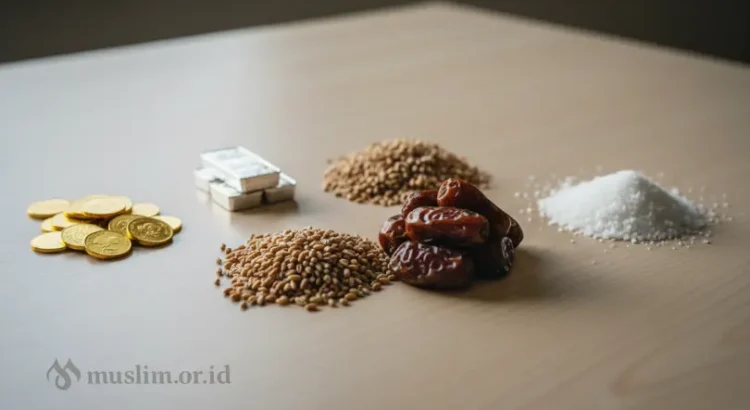
Starting from the discussion ‘perfume on gold and silver, this discussion is about ‘perfume on four other riba commodities. The four commodities are,
- Wheat
- Sha’ir (a type of wheat)
- Dates
- Salt
As in the hadith of ‘Ubadah bin Syamith, Rasulullah sallallaahu ‘alaihi wa sallam said,
Gold with gold, silver with silver, wheat with wheat, barley with barley, dates with dates, salt with salt, the like, the like. Likewise, hand to hand. If these items are different, then sell them as you wish if done in person.
“If gold is sold for gold, silver is sold for silver, wheat is sold for wheat, sya’ir (a type of wheat) is sold for sya’ir, dates are sold for dates, and salt is sold for salt, then the amount (measure or weight) must be the same and paid in cash (cash). If the types of goods are different, then you can exchange them as you like, but it must be done in cash (cash).” (HR. Muslim no. 1587)
For the four commodities above, there are standards ‘perfume usury as in gold and silver. By that standard, things are the same ‘aroma-With the four commodities above, the laws relating to usury also apply to these goods or commodities. In other words, the goods are included in the category of ribawi goods because of their harmony (similarity). ‘aroma-his with ‘perfume the four commodities above.
So what happens? ‘perfume on the four commodities above?
‘Perfume on the four riba commodities
The scholars Rahimahumullah disagree about ‘perfume of these four commodities, there are at least four opinions [1]:
First opinion: ‘Perfume usury is on goods that are weighed or measured and of the same type
This is the opinion of the Hanbali school and the Hanafi school. So starting from this opinion, there are two things that happen ‘perfume usury on the four commodities according to this opinion:
- Weighed or measured;
- Same type.
This means that all types of goods that are measured or weighed, such as rice for example, are of the same type, then the law of usury applies to them. That is, when a transaction occurs, it must be the same amount and paid in cash. Even if it is not food (such as metal, iron, and the like), it is still subject to the law of usury as long as it is weighed or measured and the type is the same.
The scholars of the Hanafi and Hanbali schools argue with the following hadith:
From Abdullah bin Umar radiyallahu ‘anhuProphet sallallaahu ‘alaihi wa sallam said,
Do not sell one dinar for two dinars, or one dirham for two dirhams, or one saa’ for two saa, because I am afraid you will become a loan shark, and taste is usury.
“Do not sell one dinar for two dinars, nor one dirham for two dirhams, nor one sha’ for two sha’. Indeed, I am worried about you ar-rimā’, and ar-rimā’ is usury.” (HR. Ahmad)
Some scholars have weakened this hadith, due to the existence of a narrator named Abu Janab Al-Kalbi, who is considered by the scholars to be the best narrator. lack of knowledge (unknown). [2]
This opinion is an opinion that can be criticized and discussed again. Apart from the hadith presented, there are also hadith dha’if, The argument from this hadith can be said to be less strong. Which mention of the word “sHa’” can’t just happen ‘perfume who influence the determination of the law. Because, if this size were the only influencing factor, it would definitely be the Prophet May Allah bless him and grant him peace Sallam will suffice with just mentioning “size”, and will not specifically mention the four types of commodities.
Second opinion: ‘Perfume riba on these four commodities is edible
This means that the law relating to usury applies to everything that is eaten. Whether the food is measured, weighed, etc. Caused ‘perfume Here, grains, side dishes, sweets, fruit, vegetables, are included in the ribawi commodity category. This means that if a transaction is carried out in the form of an exchange, the amount or nominal value must be the same and it must also be carried out in cash and cash.
As for what is not eaten, in this opinion it is not included in ribawi commodities. And that is the opinion of the Shafi’i school of thought. Proof of this opinion is the hadith of Ma’mar bin ‘Abdillah, the Prophet sallallaahu ‘alaihi wa sallam said,
Food for food, like for like
“Food is exchanged for food, so it (must be) equal.”
This opinion can be criticized from two aspects:
– Pronunciation of the hadith above, “Must be exchanged equally”, shows that what is core is not just the type of food, but there must be equality when exchange transactions occur. And “equally” does not happen, except by weighing or measuring.
So if it is said that ‘perfume The fourth commodity is food, based on this hadith, of course it is not quite right. Remembering that this hadith statement is not only about “food”, but there must be harmony, equality between the two items being exchanged.
– The narrator of the above hadith, Ma’mar bin ‘Abdillah, said at the end of the hadith,
Our food at that time was barley
“And at that time, our staple food was sya’ir (a type of wheat).” (HR. Ahmad)
So what is meant by “food” in the Ma’mar hadith May Allah bless him and grant him peace is sy’ir (wheat). And wheat is a staple type of food that is measured or weighed. So it is not correct to say that ‘perfume of the four commodities it is only “food”, and this opinion is answered (refuted) by this hadith. This hadith explains that the staple food at that time was wheat, and wheat was the food that was weighed or measured.
Third opinion: ‘Perfume riba on the four commodities is staple food and can be stored
This is the opinion of the Maliki school of thought and the opinion chosen by it Al-Imam Ibnul Qayyim God bless. Based on the hadith of ‘Ubadah bin Shamith which has been mentioned regarding six riba commodities.
According to this opinion, when the Prophet sallallaahu ‘alaihi wa sallam mentioning the types of usurious assets, it can be seen that the aim is for each type to be used as a warning (parable) for other things that are similar to it. And all of them are united by the nature of being a staple and storable food.
As for wheat (al-duri) and barley (ash-sya’ir), then him sallallaahu ‘alaihi wa sallam caution with it to cover all types of grain that can be stored. He reminded us through dates to include all kinds of sweet foods that can be stored such as sugar, honey and raisins. And he warned through salt to include all kinds of stored kitchen spices to add flavor to the food.
This opinion can also be criticized, namely the opinion that says “stored goods” are ‘perfume in punishing types of usury goods or assets. Of course this is not correct, because it is real Rutab (wet dates) the law of usury applies to them, even though wet dates are not included in stored goods (food).
Suppose “items stored” include: ‘perfume Of course usury Rutab the law of usury does not apply to him. Because Rutab not included in stored items. However, actually Rutab including usury assets.
Fourth opinion: ‘Perfume riba on the four commodities is edible which is accompanied by al-kayl (measure) and al-wazn (scales)
This opinion is the opinion chosen by Shaykhul Islam Ibn Taimiyah God bless. Based on the words of the Prophet sallallaahu ‘alaihi wa sallam in the hadith of Sa’id bin Al-Musayyib,
There is no usury except that which is measured or weighed from what is eaten or drunk.
“There is no usury except what is measured (kayl) or weighed (wazn) from something eaten or drunk.” (HR. Ad-Daruquthni)
Also the hadith of Ma’mar bin ‘Abdillah mentioned above, which shows that food can be exchanged for food provided it has the same value. And other arguments.
So according to this opinion, it is included in the category of ribawi goods if:
- Food-shaped;
- Can be weighed;
- Can be measured.
So rice, for example, falls into the category of ribawi goods. Why? Because rice is in the form of food, and can be measured. So please compare other items included in the three points above.
If we look at the postulate aspect of this opinion, it is that “equal” things cannot exist unless there are scales or measures. So this shows that it is not included in the category of usury, but rather food that is measured and weighed.
And the fourth opinion is probably a strong opinion. That is, ‘perfume in the four commodities in the form of food that can be measured and weighed. So that all types of food that can be measured and weighed, when an exchange transaction occurs, the measure or scale must be the same and must be done in cash.
God bless.
[Bersambung]
BACK TO PART 11
***
Depok, 1 Zulkaidah 1447/ 18 April 2026
Writer: Muhammad Zia Abdurrofi
Article Muslim.or.id
Footnote:
[1] This discussion can be seen in the book Fiqhul Mu’amalat Al-Maaliyah Al-Muyassar (matter. 142-144); Sahih Fiqh Sunnah/Kasyful Akinnah (5: 179-184); And Syarah Ar-Raudhul Murbi’ (6:460-462).
[2] Ash-Shaarimul Battar (p. 89); Sahih Sunnah Fiqh (p. 180); And Fiqhul Mu’amalat (p. 142).
Reference:
– Al-Muthiri, ‘Abdurrahman bin Hamud. Fiqh al-Mu’āmalāt al-Māliyah al-Muyassarah. 3rd printing. Kuwait: Imam Adz-Dzahabi Library, 2018.
– Al-Musayqih, Khalid bin ‘Ali. Syarḥ Ar-Raudh al-Murbi’. Volume 6. 1st printing. Riyadh: Dar Rakaiz, 2022.
– Abu Malik Kamal bin Sayyid Salim. Sahih Sunnah Fiqh. Volume 5 (Kasyf al-Akinnah). 2nd printing. Egypt: Maktabah At-Taufiqiyyah, 2016.
– At-Tuwaijiri, Hamud bin ‘Abdillah. Ash-Shaarimul Battar lil Ijhaazi ‘ala Man Khalafa Al-Kitab is Sunnah wal ‘Ijma’ wal Atsar. First Printing. Riyadh : Ar-Riaasah Al-‘Aamah, 1409.
PakarPBN
A Private Blog Network (PBN) is a collection of websites that are controlled by a single individual or organization and used primarily to build backlinks to a “money site” in order to influence its ranking in search engines such as Google. The core idea behind a PBN is based on the importance of backlinks in Google’s ranking algorithm. Since Google views backlinks as signals of authority and trust, some website owners attempt to artificially create these signals through a controlled network of sites.
In a typical PBN setup, the owner acquires expired or aged domains that already have existing authority, backlinks, and history. These domains are rebuilt with new content and hosted separately, often using different IP addresses, hosting providers, themes, and ownership details to make them appear unrelated. Within the content published on these sites, links are strategically placed that point to the main website the owner wants to rank higher. By doing this, the owner attempts to pass link equity (also known as “link juice”) from the PBN sites to the target website.
The purpose of a PBN is to give the impression that the target website is naturally earning links from multiple independent sources. If done effectively, this can temporarily improve keyword rankings, increase organic visibility, and drive more traffic from search results.